I can’t believe I am in a shape to type again. Last night and this morning, I was ready (at several points) to give in and call for a doctor. You have already read most of the gory details and they don’t even begin to really demonstrate how lousy I felt. I had one disposable thermometer that showed that I had a fever of 102.7 at one point. Even rolling over in bed was a breathtakingly painful experience with a stupendous headache from completely clogged sinuses. My fever broke at about 6 PM last night and I started feeling better, but then it hit me again at about 8 PM. Come morning, I was still in no shape to even walk around my room and I opted out of the morning lecture at SDM. I knew I had to get out of bed and force myself to rejoin the world and told Al to call me before the site visit to Larsen & Toubro. My morning continued with me drifting in and out of sleep, doing multiple inhalations and taking a long, hot shower at 5 AM. Since I had eaten nothing for over 24 hours, I forced myself to have some toast and cornflakes for breakfast at 9 AM.
Although I was feeling a little better, I was still a little woozy as I headed out for the L&T site visit at noon. They had laid out a sumptuous lunch for us on their campus. After that, we visited several buildings on their campus and were introduced to various L&T divisions. The “tour guide” was actually the head of EmSys, the embedded systems division of L&T. He was a fantastic speaker and very eloquent. He explained everything well and gave us a great insight into the incredible global supply chain management system that is our reality today. For example, L&T sources from Israel and manufactures on German equipment for construction projects in the United Arab Emirates using some IT managers in Mysore. They have product development teams consisting of managers from the client in the USA working with engineers in India. It was a very impressive visit – consistently fascinating. They even left each one of us with a gift. Tomorrow we go across the street to InfoSys.
In the evening, Al and I went shopping for some wine (yes, Indian wines are starting to make a mark in the industry) and a few other things. By the time we were done at about 7:30 PM, I was starting to fade and feel a little woozy again, so we headed back to the hotel and I started another round of inhalation. Still, the fact that I was able to be out almost all afternoon makes me feel better.
Showing posts with label india. Show all posts
Showing posts with label india. Show all posts
Thursday, January 10, 2008


Wednesday, January 9, 2008
Social Consciousness in India
One of the very noticeable social changes is the general optimism everyone here seems to feel about India. Even people we meet on the street seem to be very optimistic about this country’s prospects. The media seems to keep reinforcing the message that India is a major player on the world market. I have a feeling that many of us find it difficult to understand this given the poverty, filth, and infrastructure problems that are so apparent to us Americans. My theory is that things have changed so dramatically in the last ten years or so that their standard of comparison is quite different from ours. However, there is one more change that seems to jump out at me that may not be obvious to those who haven’t lived here before. I see a much stronger sense of social consciousness that I ever saw when I lived here. It’s not just the speakers who integrate examples of social cause efforts into their business presentations. Even in the commercials – so many ads seem to infuse a social cause message into their communications. There’s a cell phone ad that shows two kids staring warily across a barbed wire border and then playing soccer together (VO: There is no barrier we cannot break down if we just communicate with each other). There are ads promoting welfare of the poor, ads focusing on inter-religious brotherhood, ads showing the positive effects of good Samaritans, and much more. And the companies using these ads include business-to-business firms, service firms, and even FMCG firms. Even the mass media seems to be focused on social outrages, with news stories on child trafficking, female molestation, unfair treatment of laborers, and more. It seems like there is a clear recognition facing people here that one of the biggest problems that need to be tackled here is of poverty and disparity of wealth distribution. And if that isn’t a cause for optimism in a country like this, I don’t know what is!
In the morning we headed to a sandalwood factory and a Mysore silk factory. Both of these are government-owned enterprises and again we were confronted with the vast "contrasts" that Pavan Varma keeps talking about in the book Being Indian. We have visited spotlessly clean world-class manufacturing facilities and then there were these. The buildings were crumbling the machinery were almost a century old and the entire place was covered with dirt, dust, and cobwebs. They were proud of the fact that the boiler was imported from Lancashire, England many decades ago. Luckily the plant was not operating because they had run out of raw material (sandalwood), otherwise I'm not sure I would have been comfortable in the boiler room. The Karnataka Silk Factory was more interesting and in full operation, but they're not going to win any manufacturing process awards. Still it was fascinating to see the slender threads of silk being woven into cloth. It was also good to pick up a couple of the local specialties as gifts – sandalwood soap and silk scarves.
On a personal note, I'll admit that last night was one of the more miserable nights I have spent here. My head feels like it has expanded to three times its size and has become filled with a thick, viscous fluid. My upper chest feels the same and even breathing is not that easy. I kept waking up with uncontrollable chills. And (those of you who cannot handle gory details, look away now) every time I woke up, I found the side of my face was sorta stuck to the pillow - I assume from various secretions from my eyes and nose. When I woke up this morning, I looked forward to a HOT shower, but discovered that the water ranges from slightly luke warm to warm with no really bursts of HOT water. Same problem as last night. By the time we were done with the silk factory, I could barely stand. I had run through six handkerchiefs that were now all soaking wet and my headache was intolerable. While the rest of the group headed to SDM-IMD and lunch, about seven of us headed back to the hotel. I decided to skip lunch and crawl into bed. By this time I'm sure I had a raging fever because despite turning down the a/c, I was shivering uncontrollably in bed. I had an undershirt, a t-shirt and a sweatshirt on and I was still cold. I drifted in and out of sleep for a couple of hours and then decided to wash my handkerchiefs in a Dettol (antiseptic) solution and hang them up to dry. I didn't think it would be right to send these hankies through the hotel laundry system. I also got a bowl from the hotel, filled it with boiling water and did about 10-15 minutes of inhalation. My head still feels like it is about to explode and the two Advil don't seem to have done much good. My dinner plan with Prof. Jagadeesh is obviously off and I hope tomorrow is a better day ...
In the morning we headed to a sandalwood factory and a Mysore silk factory. Both of these are government-owned enterprises and again we were confronted with the vast "contrasts" that Pavan Varma keeps talking about in the book Being Indian. We have visited spotlessly clean world-class manufacturing facilities and then there were these. The buildings were crumbling the machinery were almost a century old and the entire place was covered with dirt, dust, and cobwebs. They were proud of the fact that the boiler was imported from Lancashire, England many decades ago. Luckily the plant was not operating because they had run out of raw material (sandalwood), otherwise I'm not sure I would have been comfortable in the boiler room. The Karnataka Silk Factory was more interesting and in full operation, but they're not going to win any manufacturing process awards. Still it was fascinating to see the slender threads of silk being woven into cloth. It was also good to pick up a couple of the local specialties as gifts – sandalwood soap and silk scarves.
On a personal note, I'll admit that last night was one of the more miserable nights I have spent here. My head feels like it has expanded to three times its size and has become filled with a thick, viscous fluid. My upper chest feels the same and even breathing is not that easy. I kept waking up with uncontrollable chills. And (those of you who cannot handle gory details, look away now) every time I woke up, I found the side of my face was sorta stuck to the pillow - I assume from various secretions from my eyes and nose. When I woke up this morning, I looked forward to a HOT shower, but discovered that the water ranges from slightly luke warm to warm with no really bursts of HOT water. Same problem as last night. By the time we were done with the silk factory, I could barely stand. I had run through six handkerchiefs that were now all soaking wet and my headache was intolerable. While the rest of the group headed to SDM-IMD and lunch, about seven of us headed back to the hotel. I decided to skip lunch and crawl into bed. By this time I'm sure I had a raging fever because despite turning down the a/c, I was shivering uncontrollably in bed. I had an undershirt, a t-shirt and a sweatshirt on and I was still cold. I drifted in and out of sleep for a couple of hours and then decided to wash my handkerchiefs in a Dettol (antiseptic) solution and hang them up to dry. I didn't think it would be right to send these hankies through the hotel laundry system. I also got a bowl from the hotel, filled it with boiling water and did about 10-15 minutes of inhalation. My head still feels like it is about to explode and the two Advil don't seem to have done much good. My dinner plan with Prof. Jagadeesh is obviously off and I hope tomorrow is a better day ...
Tuesday, January 8, 2008
Wild animals and deteriorating throat
 We woke up early this morning and headed out on a jeep into the jungle again. We waited vainly for a view of the elusive tiger, but had no luck. In addition to the multitudes of spotted deer, we saw a pack of wild dogs, a wild boar, the herd of elephants again, as well as some interesting birds. By the time we were ready to leave, my cold had exploded to the point where my nose was constantly dripping and I had several soaked handkerchiefs. By this time, my nose was raw and red, joining my
  hurting throat. I came back to Mysore in the minivan while the students braved the bouncy, broken, and dusty bus. When I got back, I went to a pharmacy and purchased some Sinarest, Cetrizine, and Benedryl with the hope that this would give me enough options to cover me for the day or two it will take to recover from this misery.
I also went out for a great haircut. The salon offered a nice haircut (including head massage), a shave, a shampoo, and a beard/mustache trim for a whopping Rs. 140 (less than $4). Very nice.
Sunday, January 6, 2008
Chamundeshwari, Srirangapattnam, Brindavan, Mysore Palace
 Today was sightseeing day. We had a busy time starting early in the morning. First, we headed to the Shri Chamundeshwari temple on the top of the Chamundi Hills that overlooks the SDM-IMD campus. It was a cool morning and the top of the hill afforded us some spectacular views of the city. After returning and grabbing some breakfast, we visited the spectacular Mysore Palace before heading to Srirangapattnam to see Tipu Sultan’s summer palace, his fort, and the bird sanctuary. Then, we went to the KRS damn and the adjoining Brindavan gardens. On our way back, we stopped back at the grounds of the Mysore Palace to see it lit up. It was like a fantasy land and a sight to see.
It was a long day, but quite fun-filled. The hard part was traveling long distances in non-air-conditioned vehicles. It is not the temperature that bothers me but the constant blowing of exhaust fumes, dust, and smoke on your face. At the end of the day, my slightly scratchy throat was raw and I could feel congestion filling my chest.

Thursday, January 3, 2008
Bound by the Supply Chain
Today’s class was on supply chain management and logistics. Although the instructor was interesting, the problem again was that the presentation went for the full one-and-a-half hours leaving no time for questions. The presentation also spent an inordinate amount of time on what supply chain management is, what the challenges of supply chain management are, etc. All the time spent on explaining why getting products to the right place and time is important seemed strange. I am guessing that our audience is interested primarily in the Indian context. That is the part these students don’t know much about and want to learn. Even when he got to the part of his presentation on SCM in India, it basically seemed like a superficial sales pitch with inane comments like:
HP is planning to double its headcount in India
Over 50 MNCs including Motorola get their chips designed in India
Even Chinese firms have started R&D centers in India
Of the Fortune 500 companies, 220 outsource to India
There were also slide after slide of lists of quality awards won by Indian companies. But, what I would have liked to know is how India is different from the US in terms of supply chain management and logistics. How do international firms manage the unique infrastructure challenges in India? How do the supply chains and logistics systems in India adapt to the unique environmental conditions in the country? Has this led to some unique innovations that have spread to other countries?
In future, we should consider positioning our interest as “access to experts” rather than lectures from faculty. Ideally, they would provide some brief background on the topic and then answer questions from the group, serving as local experts on the topic of the day.
The afternoon visit was to a company called "Automotive Axles" that was really interesting. We started with a presentation by the CFO of the company, who covered some background on the company and its growth from a sick company to one of the largest suppliers of automotive axles in the country. Their efforts improving the quality of their axles and improving the working conditions of their employees was impressive. We toured the facility and were impressed by the cleanliness and structure of the place, given it is a heavy manufacturing plant. Gene and Harvey seemed to be like kids in toyland. They went off and scrutinized details that the rest of us walked by and engaged any willing employee in conversation.
As an insight into the supply chain challenges of companies that are not fully vertically integrated, the management talked about how the lack of reliability in the supply chain results in them carrying more inventory than is optimal. Humorously, the CFO said they operate with a "Just-In-Case" model rather than "Just-In-Time." He added that a better phrase here may be "Somehow-in-Time."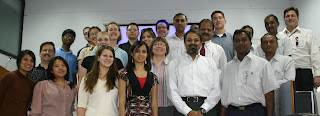
HP is planning to double its headcount in India
Over 50 MNCs including Motorola get their chips designed in India
Even Chinese firms have started R&D centers in India
Of the Fortune 500 companies, 220 outsource to India
There were also slide after slide of lists of quality awards won by Indian companies. But, what I would have liked to know is how India is different from the US in terms of supply chain management and logistics. How do international firms manage the unique infrastructure challenges in India? How do the supply chains and logistics systems in India adapt to the unique environmental conditions in the country? Has this led to some unique innovations that have spread to other countries?
In future, we should consider positioning our interest as “access to experts” rather than lectures from faculty. Ideally, they would provide some brief background on the topic and then answer questions from the group, serving as local experts on the topic of the day.
The afternoon visit was to a company called "Automotive Axles" that was really interesting. We started with a presentation by the CFO of the company, who covered some background on the company and its growth from a sick company to one of the largest suppliers of automotive axles in the country. Their efforts improving the quality of their axles and improving the working conditions of their employees was impressive. We toured the facility and were impressed by the cleanliness and structure of the place, given it is a heavy manufacturing plant. Gene and Harvey seemed to be like kids in toyland. They went off and scrutinized details that the rest of us walked by and engaged any willing employee in conversation.
As an insight into the supply chain challenges of companies that are not fully vertically integrated, the management talked about how the lack of reliability in the supply chain results in them carrying more inventory than is optimal. Humorously, the CFO said they operate with a "Just-In-Case" model rather than "Just-In-Time." He added that a better phrase here may be "Somehow-in-Time."

Wednesday, January 2, 2008
Staying Within the Law
Aaah, a good night’s sleep finally! I went to bed about 11:00 PM and woke up only a couple of times before finally getting out of bed at 7:00 AM. I count that as a solid and “normal” night’s sleep. I was able to do some reading in the morning and use the WiFi card that I was finally able to purchase (they’ve been promising me these WiFi access cards each morning and only just gave me a few yesterday) to go through some of the many emails that continue to pile up in Minnesota. Although still not as fast as I expected, it was significantly faster than the crawling Internet available at the Institute’s computer lab. Looks like I’ll have to spend more time trying to catch up on those emails. I found it fascinating that so much of the documentation in this country is still done in pen and paper. When I tried to buy the WiFi card, the guy at the reception pulled out a big green bound ledger and wrote down the details of the card and my room number in the series of columns. The ledger seems to have been pulled from the 1950s. This is in a new and modern hotel, but a lot of the accounts still seem to be done by hand.
I also got to speak with Sheila and Jay who had just arrived in Chennai. Both seemed happy and in great spirits. Sheila had to give me all the details of her business class travel on Jet Airways – sounds like she’s spoiled already.
This morning’s presentation on India’s legal system was from Mr. Shivakumar, a lawyer with a wealth of experience in a variety of areas. He was an absolutely outstanding speaker and kept the entire class enthralled. First, he kept the content of the presentation very basic. Given that most of the class knows nothing about the legal system, he didn’t get into much detail, but provided some very broad structure on the structure of the Indian legal system. Second, he kept the presentation interactive and provided brief, pertinent answers to the questions that were raised. Third, he was brutally honest about the strengths and weaknesses of the system and never appeared to be hedging or covering up. Finally, he seemed able to expand when needed to answer the questions that were raised without going off on a tangent. He answered a variety of questions that went well beyond just matters of law. The class was very impressed and delighted with his presentation.
 Right after the class and the requisite coffee break, we headed to the Mysore District Courts to see justice in action. The background provided by Mr. Shivakumar helped in understanding where we were and where these District Courts stood in the overall Indian legal system.
We first walked into a courtroom and watched the proceedings that were conducted entirely in Kannada. While there is only so much time you can sit and watch a bunch of people talking in an unfamiliar language, it was interesting to see the infrastructure and process. The room was aging and somewhat decrepit (I should note that the Court buildings themselves were beautiful in terms of architecture on the outside). The court reporter smashed away rapidfire on an ancient typewriter. Rather than just recording everything verbatim, the court proceedings appeared to be summarized by the judge every few minutes who then dictated to this reporter. There is a long table in front of the judge’s stage where a bunch of advocates just seemed to be aimlessly sitting around. Advocates would wander in and out of this room sitting at the table for a while, scribbling on a few papers, and then leaving. It was all very exotic and interesting.
We later went into another courtroom which was not in session yet. One of the advocates came over and explained that the case to be heard was a recovery case where the debtor was claiming that he did not have to repay the full amount of his promissory notes (pro-notes). The advocate who spoke to us represented the creditor and even let us leaf through the legal documents. The documents and briefs are all in English even though all the court proceedings (in the lower courts) are conducted in Kannada. We watched the proceedings for longer than most of us would have liked. Still, there were one or two testy exchanges between the lawyers that held our interest.
I managed to squeeze in a couple of faux pas moments during our visit. When the judge walked in, he looked puzzled at this large group sitting here and asked what was going on. Someone explained that this was a group visiting from the SDM management institute. He asked where we were from and from my seat, I shouted out “We’re from the University of Minnesota in the USA.” A shocked looking advocate glared at me and signaled for me to stand up when talking to the judge, which I did immediately. In another court room which was not in session, I asked our guide if it would be okay to take photographs. When he said yes, I went ahead and seated myself in the dock and asked a student to take a picture. From the far end of the room, we heard some shouting and a guy was waving wildly telling us not to take any photographs. I quickly slunk out of the room and pretended I had nothing to do with the hullabaloo.
Al and I went exploring the market street (Devraj Urs Road) in the evening. We found a music store (of course) and then a book store. The most interesting thing I bought at the music store was a CD of the High School Musical 2 soundtrack in Hindi!
Al had a great time riding the auto rickshaw there and back. He had this huge grin on his face as he filmed the traffic zipping by, the sudden jerks as the auto tried to avoid the cows and dogs on the streets and the insane scooters and motorcycles weaving in and out of the traffic around us. While this seemed quite normal to me, he found it fascinating.
The students went out and had their own adventures, from shopping in the spice market to playing cricket with some street urchins.
I also got to speak with Sheila and Jay who had just arrived in Chennai. Both seemed happy and in great spirits. Sheila had to give me all the details of her business class travel on Jet Airways – sounds like she’s spoiled already.
This morning’s presentation on India’s legal system was from Mr. Shivakumar, a lawyer with a wealth of experience in a variety of areas. He was an absolutely outstanding speaker and kept the entire class enthralled. First, he kept the content of the presentation very basic. Given that most of the class knows nothing about the legal system, he didn’t get into much detail, but provided some very broad structure on the structure of the Indian legal system. Second, he kept the presentation interactive and provided brief, pertinent answers to the questions that were raised. Third, he was brutally honest about the strengths and weaknesses of the system and never appeared to be hedging or covering up. Finally, he seemed able to expand when needed to answer the questions that were raised without going off on a tangent. He answered a variety of questions that went well beyond just matters of law. The class was very impressed and delighted with his presentation.
 Right after the class and the requisite coffee break, we headed to the Mysore District Courts to see justice in action. The background provided by Mr. Shivakumar helped in understanding where we were and where these District Courts stood in the overall Indian legal system.
We first walked into a courtroom and watched the proceedings that were conducted entirely in Kannada. While there is only so much time you can sit and watch a bunch of people talking in an unfamiliar language, it was interesting to see the infrastructure and process. The room was aging and somewhat decrepit (I should note that the Court buildings themselves were beautiful in terms of architecture on the outside). The court reporter smashed away rapidfire on an ancient typewriter. Rather than just recording everything verbatim, the court proceedings appeared to be summarized by the judge every few minutes who then dictated to this reporter. There is a long table in front of the judge’s stage where a bunch of advocates just seemed to be aimlessly sitting around. Advocates would wander in and out of this room sitting at the table for a while, scribbling on a few papers, and then leaving. It was all very exotic and interesting.
We later went into another courtroom which was not in session yet. One of the advocates came over and explained that the case to be heard was a recovery case where the debtor was claiming that he did not have to repay the full amount of his promissory notes (pro-notes). The advocate who spoke to us represented the creditor and even let us leaf through the legal documents. The documents and briefs are all in English even though all the court proceedings (in the lower courts) are conducted in Kannada. We watched the proceedings for longer than most of us would have liked. Still, there were one or two testy exchanges between the lawyers that held our interest.
I managed to squeeze in a couple of faux pas moments during our visit. When the judge walked in, he looked puzzled at this large group sitting here and asked what was going on. Someone explained that this was a group visiting from the SDM management institute. He asked where we were from and from my seat, I shouted out “We’re from the University of Minnesota in the USA.” A shocked looking advocate glared at me and signaled for me to stand up when talking to the judge, which I did immediately. In another court room which was not in session, I asked our guide if it would be okay to take photographs. When he said yes, I went ahead and seated myself in the dock and asked a student to take a picture. From the far end of the room, we heard some shouting and a guy was waving wildly telling us not to take any photographs. I quickly slunk out of the room and pretended I had nothing to do with the hullabaloo.
Al and I went exploring the market street (Devraj Urs Road) in the evening. We found a music store (of course) and then a book store. The most interesting thing I bought at the music store was a CD of the High School Musical 2 soundtrack in Hindi!
Al had a great time riding the auto rickshaw there and back. He had this huge grin on his face as he filmed the traffic zipping by, the sudden jerks as the auto tried to avoid the cows and dogs on the streets and the insane scooters and motorcycles weaving in and out of the traffic around us. While this seemed quite normal to me, he found it fascinating.
The students went out and had their own adventures, from shopping in the spice market to playing cricket with some street urchins.
Monday, December 31, 2007
Incredible India and the New Year
Today was our first day of class at the Institute. The introductory talk by an SDM-IMD professor focused on all India has been able to do despite the huge problems facing it. He talked about rays of hope emerging from social entrepreneurs who are using business systems and technology to bring some of the benefits of modernization to the rural masses – from water for crops to prosthetics for amputees. Some of his statements seems a little unbelievable and over-reaching. For example, he talked about the failures in America after 9/11 and after the Katrina disaster and compared it to the successful operations in Mumbai after the bomb blasts and the record floods. While talking about the incredible caring in India for their fellow human beings, he said that unlike America, there has never ever been any recorded case of looting in India. When the system breaks down, he said, people come together and looting stores is completely unheard of in India. Really? I seem to recall quite a bit of looting in Delhi after Indira Gandhi was shot when I was there. It was also a bit of a turn-off when a primary source for his quotes were listed on his slides as “wikipedia,” something we tell our students NOT to do. Wikipedia is a fine starting point for research, but hardly the best source to cite to build credibility.
The students headed to a new year’s eve party that evening at a local club, while Al and I chatted at the hotel before being invited to Ramesh and Thangam’s house for a quiet dinner. We had some great conversation, drank some good Indian wine and beer, and gorged on dosas, poha, and aloo tikkis.
The students headed to a new year’s eve party that evening at a local club, while Al and I chatted at the hotel before being invited to Ramesh and Thangam’s house for a quiet dinner. We had some great conversation, drank some good Indian wine and beer, and gorged on dosas, poha, and aloo tikkis.
Sunday, December 30, 2007
Corruption & Working Within the System
This morning was the engagement. After a relatively restless night’s sleep, I woke up, got ready, and we all headed to the “mandapam” for the ceremonies. There were the usual series of rituals and offerings. The most interesting was that there was actually a written contract between the parents that was read out to the gathered crowds and signed (to much fanfare) by both the parents. They essentially actually signed, in public, a written contract agreeing to have their kids marry each other. I wonder if this is an enforceable contract and if there are any specified damages in the event the engagement is later called off.
Later, while sitting around and discussing the state of world affairs, as is common in casual Indian gatherings, the conversation shifted to corruption and the ways in which people could pay bribes to get done, anything they wanted. There was one aspect of this conversation I found particularly fascinating. The group shook their head in apparent dismay when talking about how people could get almost anything past the customs officers with a well-placed bribe. They talked about how some of these processes were almost formalized, with the officer telling you how much the actual duty is and how much the unofficial duty would be if they wanted to pay under the table. They talked about how the key officials kept their hands clean and made innocuous statements that made their intention clear but never actually handled the money themselves. They could direct the person to another officer who would actually take the money and put aside a part to share informally later. All of this was said with head-shaking and a slight sense of disgust. However, they would spice each of these stories with personal examples of how they paid a bribe to get electronics pas customs, to get some paperwork expedited and more. I puzzled over how they could talk about how terrible and corrupt the system is, but still actively participate in that system. Based on my reading of Being Indian, I think that Indians may dislike a system and even consider it unethical to take bribes, but still see as using that corrupt system to achieve their goals quite acceptable. There is no moral conflict with paying bribes because that is the system. These same individuals would consider it abhorrent to ever take a bribe, but consider paying a bribe to get a task done an inevitable part of working within a corrupt system. The question always is, “what is the alternative?” If you don’t pay these bribes, you’ll never get anything done. So, some ethically questionable actions that are in the pursuit of acceptable goals is seen just as a part of getting through life. Maybe Pavan Varma is on to something. That afternoon, we headed toMysore 
Later, while sitting around and discussing the state of world affairs, as is common in casual Indian gatherings, the conversation shifted to corruption and the ways in which people could pay bribes to get done, anything they wanted. There was one aspect of this conversation I found particularly fascinating. The group shook their head in apparent dismay when talking about how people could get almost anything past the customs officers with a well-placed bribe. They talked about how some of these processes were almost formalized, with the officer telling you how much the actual duty is and how much the unofficial duty would be if they wanted to pay under the table. They talked about how the key officials kept their hands clean and made innocuous statements that made their intention clear but never actually handled the money themselves. They could direct the person to another officer who would actually take the money and put aside a part to share informally later. All of this was said with head-shaking and a slight sense of disgust. However, they would spice each of these stories with personal examples of how they paid a bribe to get electronics pas customs, to get some paperwork expedited and more. I puzzled over how they could talk about how terrible and corrupt the system is, but still actively participate in that system. Based on my reading of Being Indian, I think that Indians may dislike a system and even consider it unethical to take bribes, but still see as using that corrupt system to achieve their goals quite acceptable. There is no moral conflict with paying bribes because that is the system. These same individuals would consider it abhorrent to ever take a bribe, but consider paying a bribe to get a task done an inevitable part of working within a corrupt system. The question always is, “what is the alternative?” If you don’t pay these bribes, you’ll never get anything done. So, some ethically questionable actions that are in the pursuit of acceptable goals is seen just as a part of getting through life. Maybe Pavan Varma is on to something. That afternoon, we headed to

Subscribe to:
Posts (Atom)